The Sabbath Rest
The word Sabbath comes from the Hebrew shabath (שבת), which simply means "to cease" or "to stop". It is not primarily a day of religious ritual — it is a day of ceasing. The Jewish day does not run midnight to midnight; it runs evening to evening, following the pattern set at creation. The Bible says:
"...And the evening and the morning were the first day" — Genesis 1:5
So the Sabbath begins Friday at sundown and ends on Saturday at sundown — a full day bracketed by rest on both ends. This detail matters more than it first appears. Before a single word of Sabbath law was ever given at Sinai, the rhythm of ceasing was already written into the fabric of time itself. The Bible says:
"And on the seventh day God ended his work which he had made; and he rested on the seventh day from all his work which he had made. And God blessed the seventh day, and sanctified it: because that in it he had rested from all his work which God created and made" — Genesis 2:2-3
God did not rest because He was tired or depleted. Omnipotence does not tire. He rested because the work was finished — complete, good, and lacking nothing. His rest was a declaration, not a recovery. This is the first and most important thing to understand about Sabbath rest: it is not primarily about physical recovery from exhaustion. It is about entering the completeness of a finished work. This is why the Sabbath was blessed and made holy before the fall of man, before sin, before there was ever a body that could grow tired.
When God placed man in the Garden of Eden, He gave him work: "to dress it and to keep it" (Genesis 2:15). Work was never a punishment — it was part of the blessing of Eden, given to a man who walked with God in the cool of the day. Labor and communion with God were never meant to compete with each other.
All of that changed at the fall of man. Work itself did not become evil, but it became burdened — striving, sweat, sorrow, and toil entered what had once been simple stewardship. The very ground that had been the setting for fellowship became the ground of frustration. Because man sinned, God cursed the ground in judgement saying:
"Cursed is the ground for thy sake; in sorrow shalt thou eat of it all the days of thy life... In the sweat of thy face shalt thou eat bread" — Genesis 3:17, 19
The very curse pronounced over a garden was answered, centuries later, in another garden. The Gospels record that Jesus' first drops of Blood in His passion were shed not at the cross, but at the Garden of Gethsemane. The Bible says:
"And being in an agony he prayed more earnestly: and his sweat was as it were great drops of blood falling down to the ground" — Luke 22:44
It is a striking symmetry: in the Garden of Eden, the ground was cursed, and man's sweat became the sign of that curse. In the Garden of Gethsemane, the sweat of the Son of God — mixed with Blood — fell on the ground and began to redeem it. The same soil that swallowed the curse in one garden received the price of its reversal in another. The Bible says:
"Christ hath redeemed us from the curse of the law, being made a curse for us" — Galatians 3:13
Because of Jesus Christ, work no longer has to be striving against a curse. We are invited to labor from a finished work rather than toward one — to work at rest, not for rest. This is why the writer of Hebrews can say:
"There remaineth therefore a rest to the people of God. For he that is entered into his rest, he also hath ceased from his own works, as God did from his" — Hebrews 4:9–10
The writer of Hebrews doesn't name Jesus in verse 9–10 explicitly, but the whole letter is building toward Him as the one who finishes the work no one else could finish — so that, entering God's rest now means resting in what Christ accomplished, not what you're still trying to accomplish. Jesus offering Himself is the rest the Sabbath pointed to. This verse is Hebrews making that case in Old Testament terms — the land of Canaan pointed forward, Joshua pointed forward, the weekly Sabbath pointed forward, and all three still point past themselves to a rest that "remaineth" — available now, entered by ceasing to labor for what has already been given. Put simply: a person doesn't stop working, comparing life, or facing hardship — they stop treating their own effort as the thing holding them up. The posture shifts from proving, to trusting, from anxious labor, to confident labor, from a career/promotion/identity that they're building, to one they're receiving. Jesus made a claim that startled the religious leaders of His day:
"The sabbath was made for man, and not man for the sabbath: Therefore the Son of man is Lord also of the sabbath" — Mark 2:27–28
The Sabbath was never meant to be a cage of rules; it was a gift, and the One who gave it has full authority over what it means and how it is kept. He is not offering a 24-hour pause — He is offering Himself as the rest the Sabbath always pointed toward. Jesus says:
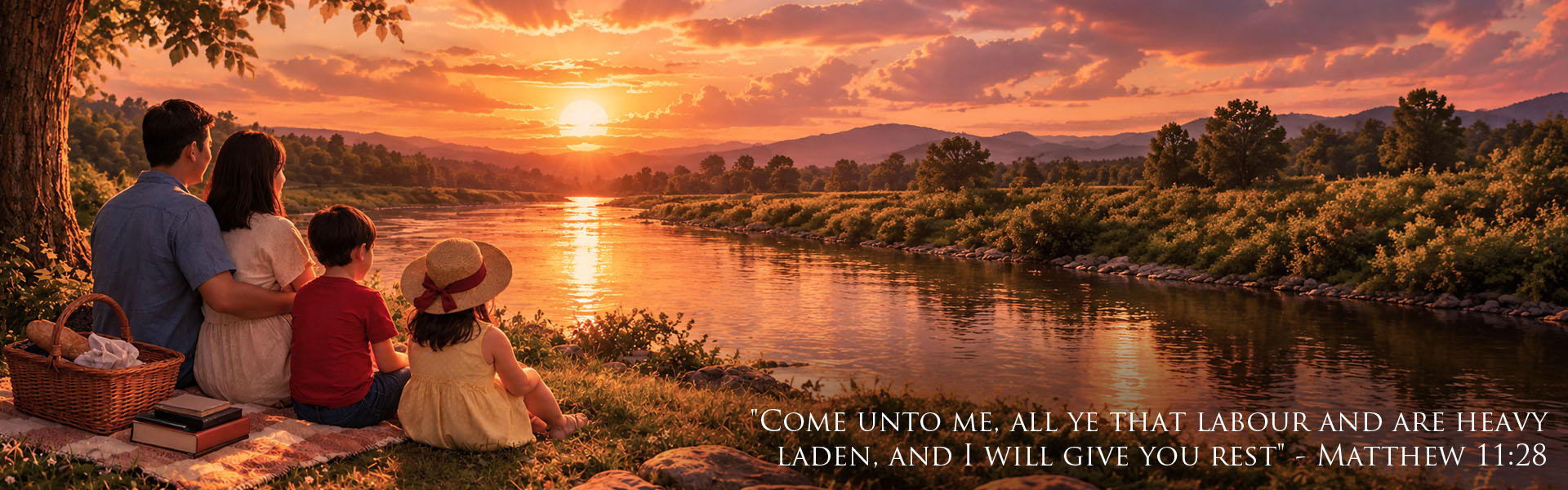
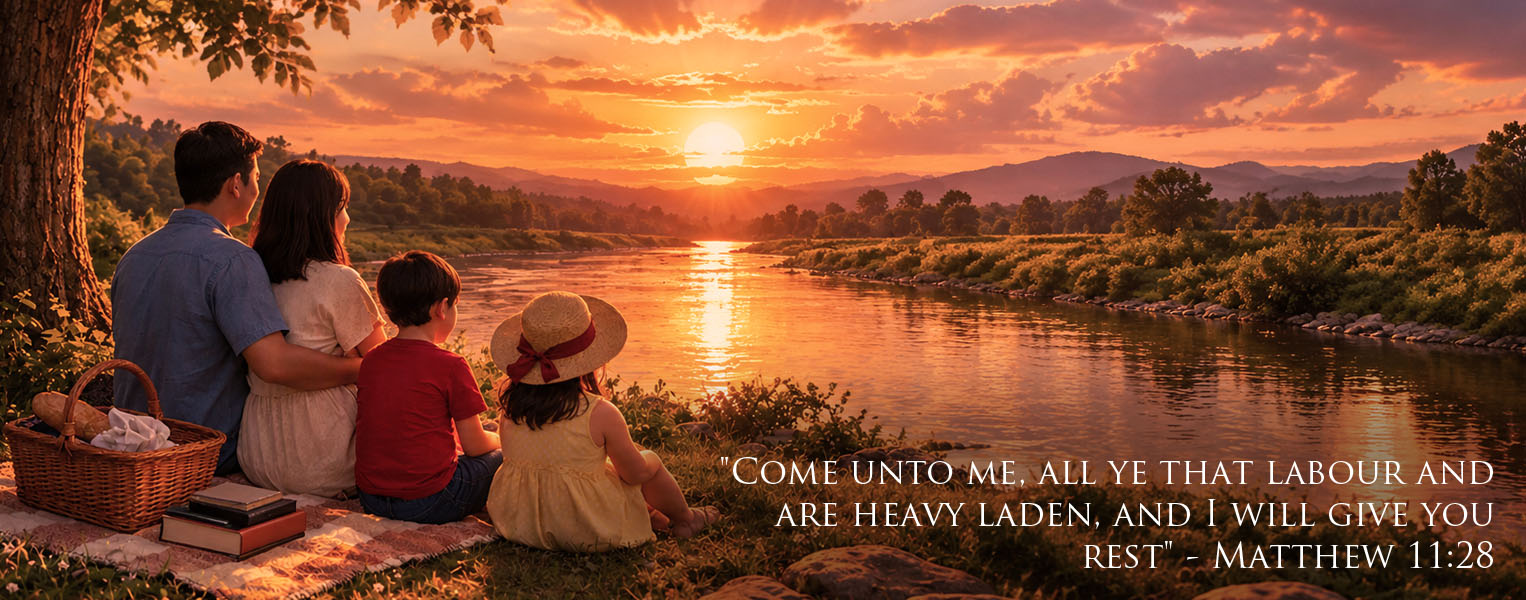
"Come unto me, all ye that labour and are heavy laden, and I will give you rest" — Matthew 11:28
"Lord of the Sabbath" means He controls what it was always for. By claiming Lordship over the Sabbath, Jesus isn't just claiming authority to bend a rule — He's claiming to be the reality the sign was built to signify. A sign is only meaningful because of what it points to; once you have the thing itself, the sign has done its job. That's why the rest He offers isn't confined to Saturday, or to any single day at all — it's a continual position which we which have believed, do enter into rest (Hebrews 4:3) available every day, because it was never really about the calendar. It was about ceasing from self-effort and resting in the finished work — and Jesus Christ is that finished work.
Rest is written into us. In 1793, revolutionary France attempted to replace the seven-day week with a ten-day one — the décade — as part of a broader effort to rationalize the calendar and strip it of religious association. On paper it was tidy. In practice it was a disaster. Workers resented nine straight days of labor with only one day off in ten. Merchants lost track of market days. Livestock, accustomed to a seven-day rhythm, reportedly struggled under the new schedule. Many people quietly kept observing Sunday regardless of what the official calendar said. The experiment collapsed under its own impracticality, and by 1806, under Napoleon, France returned to the traditional seven-day week.
It is a curious secular footnote to an ancient command — evidence that the rhythm of six and one is not an arbitrary cultural preference but something closer to the grain of creation itself. Even a society that tried deliberately to erase it could not make an alternative work.
If work no longer has to be a curse, what does it look like to actually work from rest instead of striving for it? Three areas of surrender stand out:
1. Let the Lord choose your career: The One who formed us knows what we were made for. A career chosen mainly because the pay is good, at the cost of time with God and family, tends to leave a person prosperous and empty at the same time. The Lord says:
"For I know the thoughts that I think toward you, saith the LORD, thoughts of peace, and not of evil, to give you an expected end" — Jeremiah 29:11
2. Let the Lord guide your daily work: This means surrendering not just the big decision of career, but the daily management of time, talents, treasures, resources, and health. There is little sense in spending the first half of life chasing money, and the second half spending it to repair a body that was never allowed to rest. A body denied rest will eventually demand it. The Bible says:
"Trust in the LORD with all thine heart; and lean not unto thine own understanding" — Proverbs 3:5
3. Let the Lord be in charge of promotion: Comparison is one of the fastest routes to burnout. When Apostle Peter, having just been told the cost of his own calling, turned and pointed at Apostle John and asked Jesus, "Lord, and what shall this man do?" Jesus answered, "If I will that he tarry till I come, what is that to thee? follow thou me" (John 21:21–22). The rebuke was gentle but clear: comparison is a distraction from following.
To keep the Sabbath then, is more than abstaining from labor — it is a declaration of trust. Spending the day with the Lord and with family is a way of saying, in practice, that He is the one managing the career, the workload, and the promotion, not us. Rest becomes an act of faith rather than an act of laziness. The principle extends beyond people. God commanded:
"Six years thou shalt sow thy field... but in the seventh year shall be a sabbath of rest unto the land" — Leviticus 25:3–4
Even the soil was entitled to cease and be renewed. It is a fitting bookend: man was formed from the ground — Adam's name is drawn from the Hebrew (אדם) for red earth — and the same rhythm of rest given to the ground was given to the man made from it. To rest is not a failure to trust God for provision; it is the trust.
From the seventh day of creation to a cursed garden, to a bloodied garden that reversed the curse, to a Lord who calls Himself the Sabbath's master — the thread running through all of Scripture is the same: rest is not the reward earned after work is done. In Christ, rest is the ground upon which work is done from, not someday only, but even now, one day in seven physically, and every day in the spirit.