
If God is Good, why is there Evil?
Almost everyone asks this question at some point. We watch the news, we lose a loved one, we get betrayed by a friend, and the question rises up on its own: if God is good, why is there evil? This article walks through that question the way the Bible answers it — starting with what evil actually is, and ending with the hope that carries us through it.
The Bible doesn't treat evil as a mysterious force floating in the universe. It defines evil simply as anything that goes against the character and commands of God. God is good, holy, and loving. The Bible says:
"O taste and see that the LORD is good: blessed is the man that trusteth in him" — Psalms 34:8
"He that loveth not knoweth not God; for God is love" — 1 John 4:8
So evil is whatever opposes that goodness — whether it's a sinful choice a person makes, or the suffering, disease, and disaster that results from a broken world. God's Word says:
"All wrongdoing is sin" — 1 John 5:17
So evil isn't a "thing" God made alongside light and matter. It's the absence and opposition of what is good — the way darkness is the absence of light.
We Live in a Fallen World. God could have made a world of robots — creatures with no ability to choose anything but good. But a world like that would have no such thing as love either, because love only means something when it's freely chosen. God instead made humans with real freedom to choose between good and evil. Moses said to the Israelites:
"I call heaven and earth to record this day against you, that I have set before you life and death, blessing and cursing: therefore choose life, that both thou and thy seed may live" — Deuteronomy 30:19
Adam and Eve used that freedom to disobey God, and that single choice broke the world. Genesis 3 tells us how sin entered through one man, and death and suffering followed after it. The Bible says:
"Wherefore, as by one man sin entered into the world, and death by sin; and so death passed upon all men, for that all have sinned" — Romans 5:12
Cause and effect took hold — "the fall" didn't just affect Adam, it affected the ground itself, the animals, and every person born after him. God said:
"And unto Adam he said, Because thou hast hearkened unto the voice of thy wife, and hast eaten of the tree, of which I commanded thee, saying, Thou shalt not eat of it: cursed is the ground for thy sake; in sorrow shalt thou eat of it all the days of thy life; Thorns also and thistles shall it bring forth to thee; and thou shalt eat the herb of the field; In the sweat of thy face shalt thou eat bread, till thou return unto the ground; for out of it wast thou taken: for dust thou art, and unto dust shalt thou return" — Genesis 3:17-19
We don't live in the world God originally made "very good" (Genesis 1:31); we live in a world groaning under the weight of that first act of rebellion (Romans 8:22). The Lord says:
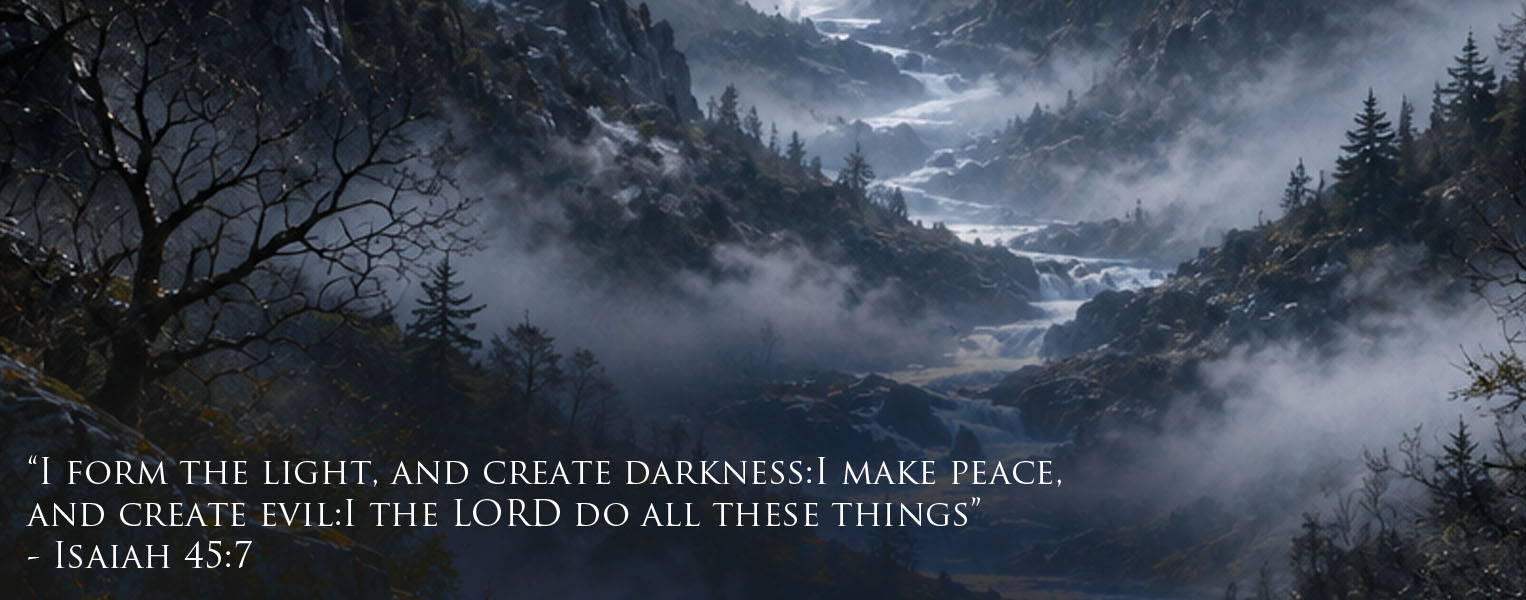
"I form the light, and create darkness: I make peace, and create evil: I the LORD do all these things" — Isaiah 45:7 (KJV)
At first glance, Isaiah 45:7 (KJV) looks like God is claiming to have manufactured moral evil. But the Hebrew word behind "evil" here is ra (רע), a word with a wide range of meaning — it can mean moral wickedness, but it can also mean calamity, disaster, or hardship. The structure of the verse is what settles it: God is not pairing "righteousness" with "sin". He's pairing "light" with "darkness", and "peace" with "calamity". Modern translations reflect this — the NIV renders it "I bring prosperity and create disaster" and the NASB and ESV use "calamity". When the Lord says "I, the Lord, do all these things", it is a stamp of ownership. It was intended to comfort the exiled Israelites in Babylon. If God is in control of the "disaster" (their exile), He is also the only one with the power to create the "peace" (their return home). God is declaring His sovereign control over the events of history — blessing and judgment alike — not claiming to be the author of sin. Apostle James makes this distinction crystal clear in his letter:
"Let no man say when he is tempted, I am tempted of God: for God cannot be tempted with evil, neither tempteth he any man" — James 1:13
If God isn't the author of moral evil, why does He allow it to continue? Jesus gives us a window into His answer in John chapter 9. His disciples met a man born blind and asked Him, "Who sinned, this man or his parents, that he was born blind?" It was the natural question — surely such suffering must be someone's fault.
Jesus's answer overturned their assumption, He said:
"Neither hath this man sinned, nor his parents: but that the works of God should be made manifest in him" — John 9:3
The man's blindness wasn't a punishment. It was an opportunity — a stage on which God's glory and power would be displayed when Jesus healed him. This doesn't answer every "why" for every hardship, but it teaches us something vital: God can use even the pain we don't understand as the very setting where His glory shows up most clearly.
The Bible never presents evil as something that catches God off guard or limits His rule. Job, after losing everything, still declared, "I know that thou canst do every thing, and that no thought can be withholden from thee" (Job 42:2). Daniel tells us that God "removeth kings, and setteth up kings" (Daniel 2:21), and that "the most High ruleth in the kingdom of men" (Daniel 4:17). Evil operates only within boundaries God permits and only for a season He has already decided. He is not wringing His hands over the state of the world — He is still on the throne.
Then how God uses evil to bring about good? The clearest picture of this truth is the cross itself. The crucifixion of Jesus was the single most evil act in human history — the murder of the sinless Son of God, driven by betrayal, corrupt courts, and brutal violence. Yet that same act became the means of the world's redemption. Peter told the crowd in Jerusalem:
"Him, being delivered by the determinate counsel and foreknowledge of God, ye have taken, and by wicked hands have crucified and slain: Whom God hath raised up, having loosed the pains of death: because it was not possible that he should be holden of it" — Acts 2:23-24
Joseph in the Old Testament said something similar to the brothers who once sold him into slavery. He said:
"But as for you, ye thought evil against me; but God meant it unto good, to bring to pass, as it is this day, to save much people alive" — Genesis 50:20
The cross — once the world's most feared instrument of Roman execution — is today the universal symbol of Grace and Salvation. God didn't merely survive the worst evil imaginable; He turned it into the hinge point of history's rescue.
In 1 Samuel 22-24, we see King David spending years (10 years according to some Rabbinic tradition) running from King Saul, hiding in caves like Adullam and En Gedi, sleeping in the wilderness, hunted like an animal despite having done nothing wrong. In the middle of that darkness, David wrote some of his rawest psalms — psalms full of fear, exhaustion, and pleading. Yet he also wrote:
"For his anger endureth but a moment; in his favour is life: weeping may endure for a night, but joy cometh in the morning" — Psalms 30:5
God didn't rescue David instantly. He let the season in the caves run its course. But it did end — Saul fell, and David became king exactly as God had promised through Samuel years earlier. The caves were real, and so was the crown that came after them.
The apostles who carried the Gospel of Grace across the Roman Empire paid for it with their lives. Paul was beaten, shipwrecked, imprisoned, and eventually executed. He wrote from that very kind of suffering:
"For I am now ready to be offered, and the time of my departure is at hand. I have fought a good fight, I have finished my course, I have kept the faith" — 2 Timothy 4:6-7
Tradition holds that nearly all the apostles died as martyrs for proclaiming Christ, and yet — the Gospel didn't die with them. It spread further because of their deaths, not in spite of them. Tertullian, an early Christian writer, famously observed that the blood of believers only multiplied the church. Two thousand years later, the message these men were killed for proclaiming is still being preached in every nation on earth.
The French Enlightenment philosopher, Voltaire (1694–1778), was a fierce critic of Christianity and reportedly predicted that within a hundred years, the Bible would be a forgotten relic, found only in secondhand shops. A popular story tells that his own former estate near Geneva, Les Délices, later passed into the hands of a family connected to Colonel Henri Tronchin, a leader in the Geneva Evangelical Society, was at one point used to store Bibles there in the 1800s — a detail people love to retell as poetic justice.
Whatever the exact details of that particular story, the larger point stands undeniably true: nearly three centuries after Voltaire's confident prediction, the Bible still remains the best-selling, most-translated book in human history. Isaiah wrote it plainly:
"The grass withereth, the flower fadeth: but the word of our God shall stand for ever" — Isaiah 40:8
Evil, and even the confident scorn of clever men, cannot silence what God has spoken. So where does this leave us? Christians in many parts of the world, even today, are persecuted, mocked, or worse, executed for following Jesus — just as David was hunted and the apostles were martyred. Evil hasn't disappeared. But the Bible never asks us to pretend it has. It asks us to hold onto something bigger than the evil we see. Apostle Paul wrote from his own suffering:
"We know that all things work together for good to them that love God, to them who are the called according to his purpose" — Romans 8:28
Not that all things are good — but that God is able to weave even the worst of them into something good, exactly as He did at the cross. Beyond that, we hold onto a promise still to come. The Bible says that when Christ returns God will wipe away all our tears:
"And God shall wipe away all tears from their eyes; and there shall be no more death, neither sorrow, nor crying, neither shall there be any more pain: for the former things are passed away" — Revelation 21:4
Isaiah pictures His coming kingdom this way:
"The wolf also shall dwell with the lamb, and the leopard shall lie down with the kid; and the calf and the young lion and the fatling together; and a little child shall lead them. And the cow and the bear shall feed; their young ones shall lie down together: and the lion shall eat straw like the ox. And the sucking child shall play on the hole of the asp, and the weaned child shall put his hand on the cockatrice' den" — Isaiah 11:6-8
A thousand years of His righteous reign on earth, with evil finally, fully undone. Until that day, we are not called to despair, and we are not called to pretend evil doesn't exist. We are called to what the earliest disciples did in the face of their own suffering: to keep proclaiming the Gospel of Grace, holding onto the certainty that the God who turned a cross into salvation, and a cave into a crown, will one day turn this whole broken world into the Kingdom where He reigns, and evil is no more.
There is one more shift the Bible calls us to make, and it changes everything about how we live in a fallen world. Left on our own, our natural question stays fixed on ourselves: why does God allow evil? Why does He allow it to touch me, my family, my world? It's not a wrong question to ask — even Job and David asked it honestly. But the Bible points us toward a better question to settle into: Lord, how do You want to use me, right here, in the middle of this broken world, for Your Kingdom? Our Lord Jesus Himself modeled exactly this shift for us in two places.
First, He taught His disciples to pray, "And lead us not into temptation, but deliver us from evil" (Matthew 6:13). Notice what this prayer does not ask. It doesn't ask God to explain why evil and temptation exist in the world. It asks God for something far more practical and far more useful — for deliverance and protection as we walk through it, and for the strength to be kept from falling into it ourselves. It is a prayer of dependence, not a prayer of debate. Hebrews 7:25 states that Jesus Christ always lives to intercede for those who draw near to God through Him, emphasizing the permanent nature of His priestly role.
Second, in the garden of Gethsemane, facing the most agonizing suffering anyone has ever faced, Jesus prayed, "O my Father, if it be possible, let this cup pass from me: nevertheless not as I will, but as thou wilt" (Matthew 26:39). Jesus was honest with the Father about the pain — He asked for the cup of suffering to be removed. But His prayer didn't stop at His own comfort. It ended in surrender: not my will, but Yours be done. That surrendered cup became the very means by which the whole world was redeemed.
This is the pattern for us. Instead of asking God to justify Himself for the evil we see, we're invited to bring Him our honest pain — and then surrender our will to His, and ask to be used by Him right in the middle of it. If the Lord allows something in our lives, He will use it for His glory. Apostle Paul described this posture as being an "ambassador for Christ", entrusted with "the word of reconciliation" (2 Corinthians 5:19-20) even while suffering himself. This isn't about throwing in the towel or accepting defeat — it's the deepest kind of purpose a person can find. When we stop demanding God for an explanation for evil, and instead, ask to be sent into it as messengers of the Gospel of Christ's death, burial, and resurrection (1 Corinthians 15:3-4), we discover a fulfillment that circumstances can never take away. Our suffering stops being meaningless and becomes, instead, the very platform from which we get to declare the good news — just as it was for David in the caves, for Paul in his chains, and for every believer since who has counted it a privilege, not a burden, to be used by God in His Kingdom, looking forward for the return of our Lord and Savior Jesus Christ.